
Why Choose Granite for Countertops and Construction?
Why Choose granite for Countertops and Construction?
Granite remains a trusted material for kitchens, bathrooms, façades, stairs, and commercial interiors. It forms deep underground under intense heat and pressure. That origin gives each slab remarkable density, strength, and visual character. A polished surface can handle busy mornings, hot cookware, and frequent cleaning. Still, granite is not indestructible. Sharp impacts can chip an exposed edge, and careless installation may create stress fractures.
Jim Hieb, former executive director of the Natural Stone Institute, offers a useful industry principle: “Evaluate stone for performance, not appearance alone.” That advice matters when comparing samples under showroom lighting. Ask about absorption, finish, thickness, edge profiles, and the fabricator’s experience. A honed black granite may reveal fingerprints more easily than a lighter, speckled surface. Some varieties also need periodic sealing, even when their daily maintenance remains simple. Small details matter.
The strongest case for granite is practical and personal. Its natural patterns cannot be perfectly repeated, so the finished countertop feels genuinely individual. Properly selected granite can support decades of use, reducing the need for early replacement. It also resists ordinary kitchen heat better than many synthetic alternatives. However, color preference should not lead the decision. A dramatic slab may show stains, seams, or scratches more clearly. I would inspect the actual slab, not only a digital photograph. That step is easy to skip. It should not be. Granite offers durability, but good results depend on accurate measurement, skilled fabrication, sound support, and realistic maintenance expectations.
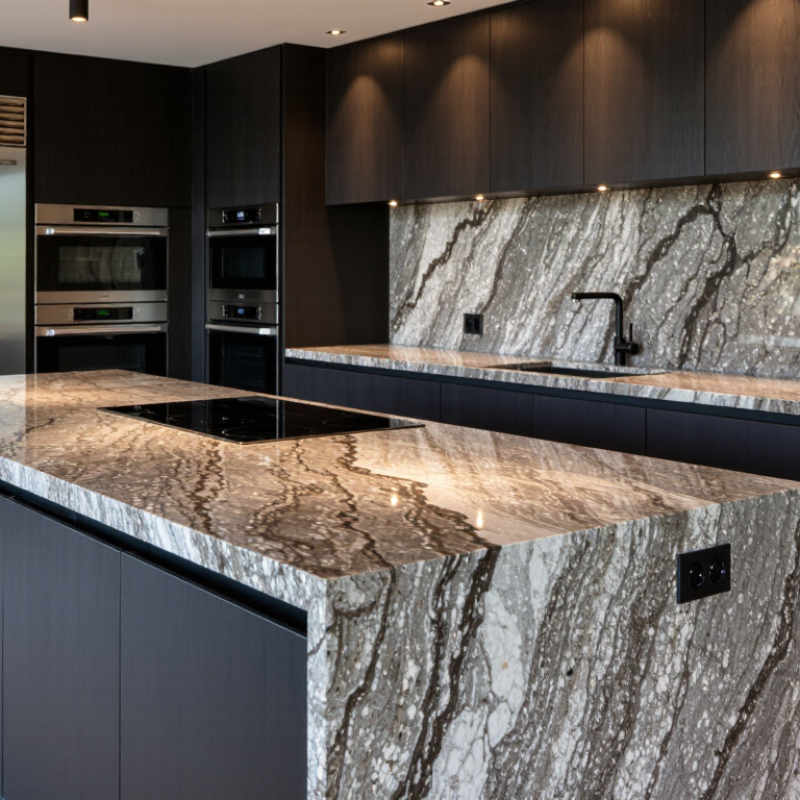
Granite Composition and Classification: Mohs Hardness of 6–7
Granite is an intrusive igneous rock formed when molten material cools slowly beneath the Earth’s surface. This process creates visible, interlocking crystals. Its main minerals are quartz, feldspar, and mica. Quartz usually reaches 7 on the Mohs scale, while feldspar measures about 6. Mica is softer and may scratch more easily. As a rock, granite commonly falls between 6 and 7 in practical hardness. It is generally classified as a coarse-grained, felsic, plutonic stone. However, mineral proportions vary between deposits.
Hardness helps explain granite’s performance on countertops, steps, and building facades. A properly finished surface can resist ordinary scratching from cookware, tools, and daily contact. It is not scratch-proof. Sand, ceramic grit, and careless handling can still damage polished areas. The Mohs scale measures scratch resistance, not impact strength, weight capacity, or stain resistance. That distinction matters. A hard slab may still chip along a thin edge or crack around a poorly supported cutout. I have seen specifications treated as guarantees, which is a mistake. Inspect the grain, fissures, and edge profile before fabrication. Dense granite often performs reliably, but porous zones may absorb oil or colored liquids. Sealing can reduce this risk, though it cannot correct weak structure or careless installation.
| Category | Data Dimension | Typical Value or Classification | Construction and Countertop Significance |
|---|---|---|---|
| Geology | Rock type | Coarse-grained intrusive igneous rock | Granite forms when magma cools slowly beneath the Earth's surface, allowing visible mineral crystals to develop. |
| Composition | Primary minerals | Quartz, alkali feldspar, and plagioclase feldspar | These minerals create granite's interlocking crystalline structure, which contributes to strength, durability, and distinctive natural patterns. |
| Composition | Quartz content | Approximately 20–60% of the light-colored mineral fraction | Quartz is resistant to scratching and chemical weathering, although it can still be affected by severe impact or concentrated abrasive action. |
| Classification | Common mineral classification system | QAPF classification | Geologists classify plutonic rocks using the relative proportions of quartz, alkali feldspar, plagioclase, and feldspathoids. True granite occupies a quartz-bearing field in this system. |
| Hardness | Overall Mohs hardness | Approximately 6–7 | The exact value varies with mineral composition. Quartz is Mohs 7, while feldspar is generally Mohs 6, so different granite varieties may respond differently to scratching. |
| Hardness | Scratch resistance | High for normal household and building use | Granite generally resists scratches from common materials, but abrasive grit, hard mineral particles, and improper cutting tools can damage the polished surface. |
| Durability | Abrasion and wear resistance | Generally high | Its interlocking mineral grains make granite suitable for floors, stairs, wall cladding, vanities, worktops, and other high-use surfaces. |
| Heat performance | Response to ordinary kitchen heat | Generally good, with thermal-shock limitations | Granite tolerates moderate heat better than many synthetic surfaces, but sudden temperature changes or direct contact with very hot cookware may cause cracking or discoloration. |
| Moisture | Porosity and water absorption | Variable by variety and finish | Granite is not completely nonporous. Some varieties benefit from periodic sealing to reduce staining and moisture penetration, especially in kitchens and bathrooms. |
| Chemical resistance | Resistance to common household substances | Good, but acids may dull polished surfaces | Quartz-rich granite is generally durable, but acidic substances can attack minerals or sealers. Prompt cleanup helps reduce etching and staining risks. |
| Appearance | Natural visual characteristics | Granular texture with varied colors and crystal patterns | Color and pattern depend on mineral proportions, grain size, alteration, and geological origin. Each slab can show natural variation. |
| Fabrication | Cutting and finishing requirements | Diamond tooling and professional fabrication recommended | The high hardness and density that improve durability also make granite difficult to cut, drill, polish, or modify without suitable equipment. |
| Structural use | Common construction applications | Cladding, paving, stairs, monuments, retaining elements, and architectural details | Selection should consider slab thickness, support conditions, anchoring, span, freeze-thaw exposure, and local structural requirements. |
| Maintenance | Routine care | Mild cleaner, soft cloth, and periodic condition checks | Avoid harsh acids, abrasive powders, and prolonged exposure to staining liquids. Maintenance needs vary according to surface finish and stone porosity. |
| Selection | Important evaluation factors | Hardness, porosity, finish, thickness, color variation, and intended exposure | A laboratory report or supplier technical data for the specific stone is preferable because granite properties vary significantly between geological varieties. |
| Note: Mohs hardness is a relative scratch-resistance scale, not a direct measure of breaking strength, load capacity, or impact resistance. Actual performance depends on the specific granite variety, fabrication quality, installation, and service conditions. | |||