>

What Types of Commercial Restaurant Equipment Are There?

Choosing Commercial Restaurant Equipment is less about filling a kitchen with impressive machines. It is about matching every tool to the menu, service volume, available space, and staff experience. A busy breakfast café may need a reliable griddle, two-door reach-in refrigerator, conveyor toaster, and compact dishwashing system. A pizzeria may depend on a deck oven, dough mixer, proofing cabinet, and refrigerated prep table. The differences matter.

Restaurant consultant David Scott Peters often says, “Your restaurant is only as good as your systems.” That principle applies directly to equipment planning. Refrigeration protects ingredients. Cooking equipment controls consistency. Ventilation supports a safer, more comfortable workspace. Smallwares, shelving, ice machines, and cleaning equipment complete the operation, although they receive less attention.

A perfect equipment list does not exist.

This guide examines the main types of Commercial Restaurant Equipment and explains where each category fits. It considers capacity, energy use, maintenance access, workflow, and staff safety. A six-burner range may look versatile, yet it could waste space in a limited-service kitchen. A high-speed oven may improve service, but it cannot replace every cooking method. Those trade-offs deserve honest attention.

Real kitchens are rarely perfect. Doors become crowded, storage gets underestimated, and one essential appliance eventually fails during a rush. Careful planning reduces those problems. It also leaves room for practical judgment, because the best equipment choice depends on how a restaurant truly operates each day.
What Types of Commercial Restaurant Equipment Are There?

Commercial Restaurant Equipment by Functional Category

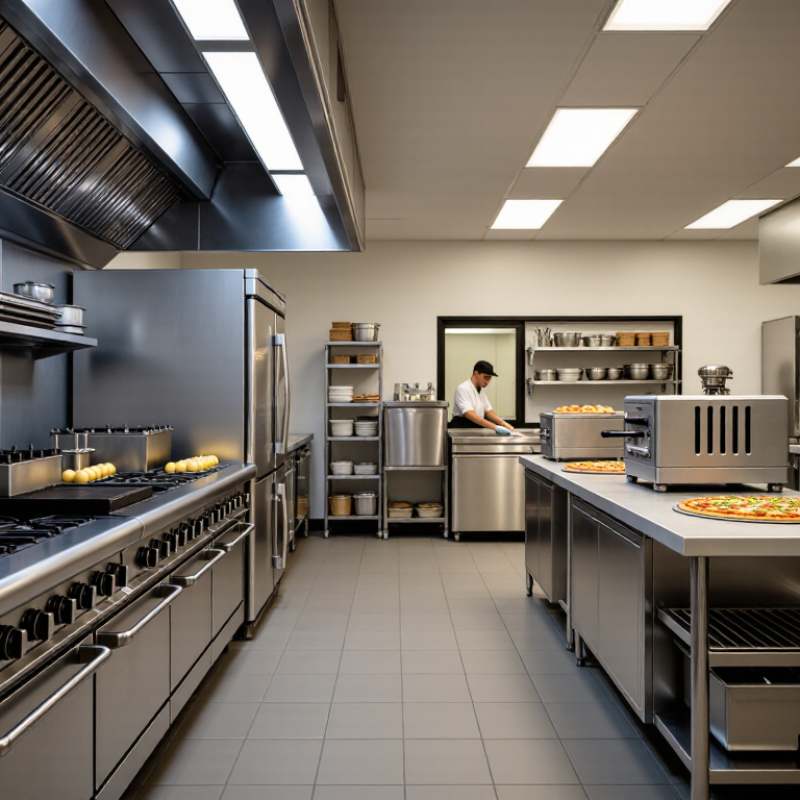
Commercial restaurant equipment is best understood by function, not by appearance. Cooking equipment includes ranges, convection ovens, combi ovens, fryers, and griddles. These units create heat, speed production, and define the kitchen’s output.

Preparation equipment covers mixers, slicers, food processors, worktables, and weighing tools. Small details matter here. A poorly placed prep table can add hundreds of unnecessary steps each shift.

Refrigeration protects ingredients and supports safe production. Walk-in units, reach-in cabinets, undercounter refrigerators, and ice machines serve different volumes and workflows.

Warewashing equipment, including sinks, dishwashers, and drying racks, controls sanitation and labor flow. Holding and service equipment keeps food at stable temperatures before delivery to guests. Ventilation systems remove heat, smoke, and grease while improving working conditions.

The U.S. Department of Energy reports that restaurants can use five to seven times more energy per square foot than other commercial buildings.

This makes efficient cooking, refrigeration, and ventilation equipment important cost decisions.

The National Restaurant Association’s 2024 State of the Restaurant Industry Report projected U.S. restaurant sales above one trillion dollars, showing the scale of daily foodservice operations.

Still, a functional category list can oversimplify real kitchens. Equipment overlap is common. A holding cabinet may support cooking, storage, and service. Operators should test actual movement, cleaning time, utility access, and peak-hour demand before purchasing. A shiny specification sheet is not enough.

Food Preparation Equipment for Commercial Kitchens

What Types of Commercial Restaurant Equipment Are There?

Food Preparation Equipment for Commercial Kitchens

Food preparation equipment shapes speed, consistency, and kitchen safety. A practical setup often begins with stainless steel worktables, cutting boards, chef knives, and calibrated scales. These tools support accurate portions and cleaner workflows during busy service.

Commercial kitchens also use food processors, mixers, slicers, peelers, and vegetable cutters. A mixer handles dough and sauces when manual preparation becomes too slow. A slicer creates even portions, but staff must receive proper training before using it. Refrigerated prep tables keep ingredients nearby and reduce unnecessary movement. Walk-in or under-counter refrigeration protects fresh produce, dairy, and prepared foods at stable temperatures.

Small details matter. A digital thermometer should be easy to read and simple to sanitize. Color-coded cutting boards can help separate raw and ready-to-eat ingredients. Deep sinks, spray faucets, drain racks, and shelving support cleaning between tasks. I have found that equipment placement often matters more than equipment size. A powerful processor becomes frustrating when staff must cross the kitchen repeatedly to use it.

Capacity should match the menu, not personal ambition. An oversized mixer may waste space and energy in a small operation. A compact unit may struggle during peak production. This judgment is not always perfect. Managers should observe actual prep times, storage needs, and cleaning habits before replacing equipment. Daily inspection still matters, especially around blades, seals, cords, and temperature controls.

Cooking and Heating Equipment for Professional Foodservice

Commercial restaurant cooking equipment includes ranges, convection ovens, combi ovens, griddles, fryers, steamers, and induction units. Each tool suits a different production rhythm. A busy breakfast kitchen may need a fast griddle, while a hospital kitchen may value controlled steaming and gentle reheating. Combi ovens can combine heat and moisture, helping maintain texture during batch cooking. Yet, operators should test actual menus first. Bigger equipment is not always better.

Heating equipment also includes holding cabinets, warming drawers, heat lamps, and pass-through shelves. These units protect food temperature between cooking and service. The U.S. Food and Drug Administration Food Code recommends holding hot food at 135°F or above. Small temperature losses matter. Door openings, overloaded shelves, and poor airflow can create uneven results.

Energy use deserves close attention. The U.S. Environmental Protection Agency’s ENERGY STAR guidance reports that restaurants can use five to seven times more energy per square foot than other commercial buildings. Efficient ovens, fryers, and steamers may reduce operating costs, but installation and staff habits still matter. The U.S. Department of Energy’s Commercial Buildings Energy Consumption Survey also highlights food-service spaces as energy-intensive environments. In practice, a neglected gasket can waste more energy than expected. Equipment selection should consider capacity, recovery speed, ventilation, cleaning time, and measured energy demand, not only purchase price.

What Types of Commercial Restaurant Equipment Are There? — Cooking and Heating Equipment for Professional Foodservice
Equipment Type Primary Function Typical Heat Source Common Operating Range Best-Suited Foodservice Applications Key Selection Considerations
Commercial Range
Cooking
Combines open burners with an oven or other cooking surfaces for versatile preparation. Natural gas, propane, or electricity Burner flame or electric surface heat; oven temperatures commonly reach approximately 150–290°C (300–550°F).
  • Sautéing and pan-frying
  • Boiling and simmering
  • General-purpose cooking in full-service kitchens
Number of burners, oven configuration, ventilation requirements, available utilities, and kitchen footprint.
Convection Oven
Baking & Roasting
Uses a fan to circulate heated air for more even and efficient cooking. Gas or electricity Commonly approximately 120–290°C (250–550°F), depending on the model and recipe.
  • Baking breads and pastries
  • Roasting vegetables and meats
  • Cooking sheet-pan meals
Pan capacity, fan speed settings, humidity control, recovery time, door design, and cleaning access.
Combi Oven
Multi-Function Cooking
Combines convection heat, steam, and a combination mode in one cooking chamber. Gas or electricity with a water connection Dry-heat cooking commonly reaches approximately 30–300°C (85–570°F); steam operation uses controlled humidity.
  • Roasting and baking
  • Steaming vegetables, seafood, and grains
  • Regenerating prepared meals
Water quality, drainage, programming controls, production volume, cleaning systems, and staff training.
Conveyor or Deck Pizza Oven
High-Temperature Cooking
Cooks pizzas and similar products using a heated deck, moving belt, or both. Gas or electricity Often approximately 230–370°C (450–700°F), depending on the cooking method and product.
  • Pizza and flatbreads
  • Open-faced sandwiches
  • High-volume quick-service production
Cooking capacity, bake time, chamber size, heat recovery, exhaust requirements, and menu consistency.
Griddle
Direct-Contact Cooking
Provides a broad, flat heated surface for cooking multiple portions at once. Gas or electricity Commonly approximately 90–315°C (200–600°F).
  • Burgers and breakfast foods
  • Pancakes and eggs
  • Toasted sandwiches and vegetables
Plate thickness, cooking-zone controls, grease management, splash protection, and ease of scraping and cleaning.
Charbroiler
Grilling
Grills food over radiant heat to create seared surfaces and grill marks. Gas, electricity, or infrared heating elements Grate temperatures commonly range from approximately 230–370°C (450–700°F).
  • Steaks, burgers, and poultry
  • Grilled seafood
  • Vegetables and specialty sandwiches
Grate material, heat-zone layout, flare-up control, grease removal, ventilation, and smoke production.
Deep Fryer
Frying
Immerses food in hot oil for rapid cooking and crisp texture. Gas or electricity Typical oil temperature is approximately 160–190°C (320–375°F).
  • French fries and fried potatoes
  • Chicken, seafood, and appetizers
  • High-volume quick-service menus
Tank capacity, recovery time, filtration, oil-use efficiency, safety features, and compatibility with the menu volume.
Salamander or Overhead Broiler
Finishing & Browning
Applies intense overhead heat for broiling, melting, browning, and finishing dishes. Gas or electricity High radiant heat; exact surface temperatures vary by design, rack position, and operating time.
  • Melting cheese
  • Browning casseroles and gratins
  • Finishing steaks, seafood, and plated dishes
Mounting height, adjustable rack positions, heat-zone control, clearance requirements, and ventilation.
Steam-Jacketed Kettle
Batch Cooking
Uses a steam-filled jacket surrounding the vessel to heat large batches evenly. Direct steam, gas, or electricity Generally suitable for controlled simmering and boiling; operating conditions depend on the jacket system.
  • Soups, sauces, and stocks
  • Gravy and liquid-based preparations
  • Institutional and central-kitchen production
Batch volume, tilting or stationary design, agitation needs, steam supply, drain access, and cleaning procedures.
Steam Table
Holding & Serving
Maintains prepared food at serving temperature using heated water wells or direct heat. Electricity or gas Hot holding is generally maintained at or above 60°C (140°F), subject to local food-safety requirements.
  • Buffets and cafeterias
  • Self-service lines
  • Prepared entrées, vegetables, and sauces
Well configuration, pan sizes, temperature control, sneeze-guard compatibility, water usage, and service-line layout.
Holding Cabinet
Hot Holding
Keeps cooked food warm while helping maintain moisture and product quality before service. Electricity, often with humidity control Commonly approximately 60–95°C (140–203°F), depending on the food and operating requirements.
  • Cook-and-hold operations
  • Banquet and catering service
  • Staged meals and high-volume production
Number of pan positions, humidity management, temperature accuracy, door seal quality, mobility, and cleaning access.
Microwave or High-Speed Oven
Rapid Reheating
Heats or cooks selected foods quickly for short-order service and finishing applications. Microwave energy, convection heat, impinged air, or a combination Performance is usually specified by power and cooking time rather than a single chamber temperature.
  • Rapid reheating
  • Prepared meals and sandwiches
  • Small-format and convenience foodservice
Power output, ventilation needs, programmable recipes, cavity size, food compatibility, and throughput.
Induction Cooktop
Precision Cooking
Uses electromagnetic energy to heat compatible cookware directly and efficiently. Electricity Temperature and power ranges vary by unit; the cookware surface heats through electromagnetic induction.
  • Sauces and delicate preparations
  • Front-of-house cooking
  • Temporary or mobile foodservice stations
Compatible cookware, electrical load, control precision, cooling requirements, surface durability, and portability.

Refrigeration, Freezing, and Food Storage Systems

Commercial restaurant equipment includes more than ovens and prep tables. Refrigeration, freezing, and storage systems protect quality from delivery to service. In a busy kitchen, temperature control is a daily safety task. Walk-in coolers hold bulk produce, dairy, and prepared ingredients. Reach-in units keep frequently used items close to the service line. Small kitchens often rely on undercounter storage. It saves steps. It also saves space.

Freezers support longer purchasing cycles and reduce avoidable waste. Chest and upright designs suit different workflows. A chest freezer may hold sealed proteins efficiently, but staff can lose items beneath newer stock. Upright shelving improves visibility and rotation. Blast chillers cool cooked food quickly when the menu and volume justify the investment. They require training, airflow, and disciplined loading. A crowded cabinet will not perform as expected. That detail is easy to miss.

Food storage systems should match actual movement, not an ideal floor plan. Use food-grade containers with tight lids, clear labels, and preparation dates. Store raw ingredients below ready-to-eat foods to reduce contamination risks. Keep cold-air vents unobstructed, and check door seals regularly. Digital temperature logs can reveal failures before products spoil. I have seen teams trust a display without checking product temperatures. That is a weak habit. Calibrated thermometers and scheduled maintenance provide stronger evidence. Equipment selection should consider capacity, energy use, cleaning access, and emergency backup plans. The cheapest unit may become expensive through repairs, waste, and lost service time.

Cleaning, Safety, and Front-of-House Equipment

Commercial restaurant equipment extends well beyond ovens and refrigerators. Cleaning, safety, and front-of-house tools protect customers while supporting faster service. The National Restaurant Association’s 2024 State of the Restaurant Industry report projected U.S. restaurant sales at about $1 trillion. That scale makes small equipment choices operationally important.

A practical cleaning setup includes a commercial dishmachine, a three-compartment sink, sanitizer test strips, mop sinks, floor drains, and covered waste containers. The FDA Food Code recommends washing hands for at least 20 seconds and maintaining cold food at 41°F or below. Hot food should remain at 135°F or above. A clean counter is not enough. Door handles, faucet levers, tablet screens, and cutting-board edges also need scheduled attention. I have seen teams trust automatic dishwashers too much. Water temperature, chemical concentration, and loading still require human checks.

Safety equipment should include slip-resistant mats, guarded slicers, cut-resistant gloves, fire suppression systems, and clearly marked wet-floor signs. Front-of-house equipment includes sneeze guards, bussing carts, receipt printers, queue barriers, accessible tables, and stable service trays. The U.S. Bureau of Labor Statistics continues to track recordable injuries in food services and drinking places, showing why prevention belongs in daily operations. A narrow aisle may look efficient during a rush. It can become a collision point within seconds. Managers should review traffic flow, cleaning logs, and staff feedback regularly, because even a well-designed layout may fail during peak service.

What Types of Commercial Restaurant Equipment Are There?

This chart groups common commercial restaurant equipment into three practical areas: cleaning, safety, and front-of-house operations. The values represent the number of distinct equipment types included in each category, not sales or market-share data.

How to read the chart: Cleaning equipment supports sanitation and maintenance, safety equipment helps reduce operational risks, and front-of-house equipment supports customer service, ordering, payments, and beverage presentation.

Newsletter

Keep up on our always evolving product features and technology. Enter your e-mail and subscribe to our newsletter.