2026 Best Restaurant Utensils for Global Buyers
Choosing the best Restaurant Utensils for global markets requires more than comparing prices or polished product photos. Buyers must examine material safety, handling comfort, cleaning performance, durability, and supply consistency. A spoon may look excellent online but feel unbalanced after eight hours of service. Small details matter.
Chef and restaurateur Thomas Keller once said, “A recipe has no soul. You, as the cook, must bring soul to the recipe.” His words also apply to professional utensils. The right tools support consistency without distracting kitchen staff. For 2026, buyers should assess stainless steel grades, food-contact compliance, heat resistance, corrosion protection, and ergonomic design. Regional requirements may differ, so suppliers should provide clear test reports and traceable documentation. Certifications help, but they do not replace practical inspection.
This guide examines Restaurant Utensils for hotels, restaurants, catering companies, and institutional kitchens worldwide. It considers serving spoons, tongs, ladles, whisks, spatulas, forks, and specialty tools. We will compare performance, lifecycle value, storage needs, and supplier reliability. The lowest quotation is not always economical. Sometimes, it creates replacement costs, staff frustration, and avoidable waste.
There is no perfect utensil.
Even careful buyers can miss something. A handle may trap moisture. A polished surface may show scratches quickly. These weaknesses deserve honest attention. The most reliable purchasing decision combines laboratory evidence, kitchen feedback, and realistic operating conditions. Global buyers should choose utensils that remain safe, comfortable, and dependable during busy service, not merely attractive during a product demonstration.
Restaurant Utensil Categories and Their Global Commercial Applications
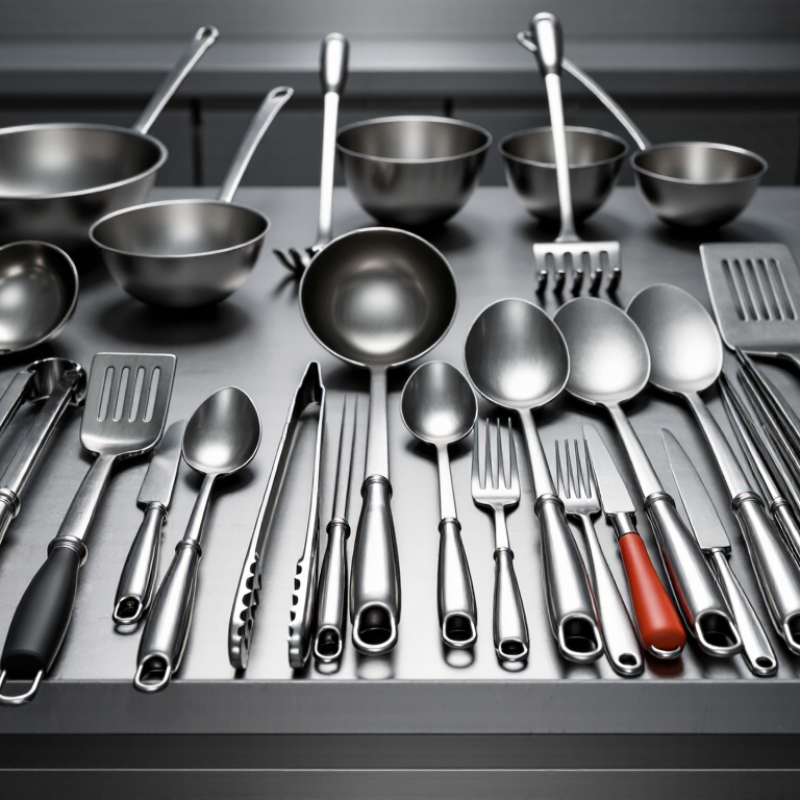
Restaurant utensils serve different commercial purposes across global foodservice markets. Cutlery supports dining rooms, cafés, catering events, and hotel breakfast services. Serving spoons, tongs, ladles, and portion scoops help control speed and food costs. Kitchen tools include whisks, peelers, spatulas, thermometers, and durable preparation knives. Each category should match the menu, kitchen volume, and working temperature.
Material selection affects safety and operating life. Stainless steel suits busy kitchens because it resists corrosion and frequent washing. Food-grade silicone protects coated cookware and handles hot sauces safely. Heat-resistant polymers can reduce weight, but buyers must verify temperature limits. In my procurement experience, comfortable grips matter during long shifts. Small design faults become expensive complaints.
Global buyers should check food-contact requirements, sanitation procedures, packaging rules, and import documents before ordering. Restaurants with outdoor service may need lightweight tools and secure storage. Fine-dining operations often prioritize balance, finish, and precise portion control. High-volume canteens usually value stackability, strength, and quick replacement. A perfect utensil program rarely exists. We sometimes overbuy specialized tools that remain unused. Reviewing breakage records and staff feedback creates a more reliable purchasing plan. Testing a small shipment first can expose weak handles, awkward sizing, or unclear cleaning instructions.
The chart compares major restaurant utensil categories by the number of common commercial foodservice settings in which they are routinely used. Applications include restaurants, hotels, catering operations, institutional dining, cafés, bakeries, bars, buffets, central kitchens, food trucks, takeaway kitchens, and casual dining. The figures represent application coverage counts, not market-share estimates.
Material Safety Benchmarks: FDA Food Code 2022 and NSF/ANSI 2
For global buyers, utensil safety begins with material behavior, not appearance. The FDA Food Code 2022 requires food-contact surfaces to be smooth, durable, corrosion-resistant, nonabsorbent, and easy to clean. These requirements matter around knife joints, rivets, and textured handles. Small gaps can hold residue after washing.
NSF/ANSI 2 evaluates commercial food equipment through material, design, construction, and performance requirements. Buyers should request current conformity evidence, not rely on a supplier’s description. The standard supports hygienic design, but it does not replace local regulatory review. The FDA Food Code is a model code, and jurisdictions may adopt different editions or amendments.
The CDC estimates that foodborne illness causes
about 48 million illnesses,
128,000 hospitalizations,
and
3,000 deaths annually
in the United States. That scale makes routine utensil control more than a purchasing detail.
FDA Food Code 2022 also addresses cleaning and sanitizing frequencies, including food-contact surfaces used with potentially hazardous foods. In practice, I would inspect welds, edges, discoloration, and drainage after repeated washing. Certification helps, but it is not magic. A utensil can meet a benchmark and still be poorly maintained. This is where buyers should reconsider price-only decisions and document inspections, replacement intervals, and cleaning conditions.
Sources: FDA Food Code 2022; NSF/ANSI 2, Food Equipment; CDC, Estimates of Foodborne Illness in the United States.
Heat, Cold, and Corrosion Performance for Professional Kitchens
2026 Best Restaurant Utensils for Global Buyers
Professional kitchens need utensils that survive more than daily stirring. They face boiling sauces, frozen ingredients, steam, ice baths, and repeated washing. Heat-resistant stainless steel remains reliable for high-temperature cooking and open-pan work. Silicone tools can protect coated cookware, but their temperature limits must be checked carefully. Some handles soften near ovens or hot equipment. That detail is easy to miss.
Cold performance matters during preparation and storage. Plastic utensils may become rigid or brittle in freezers. Choose materials tested for low-temperature use, especially in seafood, pastry, and catering operations. Corrosion resistance also deserves close attention. Stainless steel grades such as 304 or 316 can perform well, but salt, acids, and poor cleaning routines still cause staining. Welds, joints, and hidden seams often fail before the main surface. I have seen attractive tools deteriorate because moisture remained inside the handle. Appearance alone is not proof of durability.
Tips:
Request heat and cold test data from suppliers. Check whether the stated range applies to continuous use or brief contact. Inspect edges, rivets, and grip surfaces before purchase. For acidic kitchens, test a small sample with tomato sauce, vinegar, and saltwater. Do not assume dishwasher-safe means corrosion-proof. A utensil can pass one test and still disappoint under real service pressure. Replacing weak tools later may cost more than selecting simpler, stronger designs initially.
Sustainability Metrics: Reusability, Life Cycle, and EU Food-Contact Rules
Restaurant utensils should be assessed beyond purchase price. Reusability is meaningful only when items survive repeated service cycles. The United Nations Environment Programme reported in Turning off the Tap (2023) that plastic pollution could fall 80% by 2040 through reuse, recycling, and reduced consumption. However, reuse still requires washing energy, water, transport, and replacement stock.
Buyers should request life-cycle data, not vague sustainability claims. Useful metrics include expected wash cycles, breakage rates, material weight, recycled content, and end-of-life options. A 2024 report from the European Environment Agency highlights the growing importance of resource efficiency and circular product design. Real kitchens expose weaknesses quickly. A utensil may look durable, yet warp beside a commercial dishwasher. My own practical rule is simple: test samples for several weeks before placing a large order. Perfect calculations are rare.
Tips: Ask suppliers for migration-test results, a Declaration of Compliance, and clear material specifications. Under EU Regulation (EC) No 1935/2004, food-contact materials must not release substances that endanger health or change food composition. Plastic utensils also fall under Regulation (EU) No 10/2011, including specific migration limits. Check dishwasher resistance against documented testing, such as repeated-cycle methods referenced by EN 12875-1. Keep records for traceability. Do not rely on the word “eco” alone; it says little without measured evidence. One weakness remains: life-cycle studies can use different assumptions, so compare their boundaries carefully.
Global Buying Scorecard: Hygiene, Durability, Compliance, and Total Cost
For global restaurant buyers, a utensil scorecard should begin with hygiene, not appearance.
In kitchen trials, smooth seams and rounded edges cleaned faster under busy wash cycles. Avoid hidden joints where grease and moisture collect. Forks, spoons, and tongs should tolerate repeated commercial dishwashing without peeling, pitting, or retaining odors. Short drying times matter too. Test the seams. A clean utensil is not automatically a hygienic utensil. Staff handling and storage still shape the final risk.
Durability deserves measurable checks.
Record material grade, thickness, handle strength, and corrosion resistance before ordering large volumes. Test sample pieces through repeated washing, drops, and stacking. I prefer a written inspection record with batch numbers and supplier declarations for food-contact use. Compliance is not one universal stamp; requirements differ by market and application. Buyers should verify current local rules, test reports, and traceability documents. Missing paperwork is a warning sign. Yet paperwork alone cannot replace a real kitchen trial.
Total cost includes more than the purchase price.
Add freight, import handling, storage, replacement rates, labor, and disposal. A cheaper spoon may bend sooner and interrupt service during peak hours. A heavier utensil may last longer, but it can increase shipping weight and staff fatigue. Score each factor from one to five, then attach evidence. Track failures. My own scorecards are useful, but imperfect. Washing temperatures, water hardness, and staff habits can change results. Leave room for revision after thirty days of actual service.